Price action
We observe price movement as it is: candles, rejections of levels, breaks and retracements. The aim is to understand who is taking control, buyers or sellers.
Study community · Gold (XAUUSD)
A learning community dedicated to a method of reading the market applied to gold (XAUUSD): price action, market structure and liquidity. Here we study, ask questions and compare notes with fellow learners. No signals, no investment advice.

The method we study does not rely on complex indicators: it reads the gold chart starting from three simple ideas. Learning to recognise them on your own chart is the core of the study path.
We observe price movement as it is: candles, rejections of levels, breaks and retracements. The aim is to understand who is taking control, buyers or sellers.
We identify significant highs and lows to establish the trend (bullish, bearish or sideways) and recognise when the structure changes. Entries are studied in the direction of the structure.
Many orders (for example stop losses) build up above obvious highs and below obvious lows. These are zones where price often tends to react, and we learn to take them into account when evaluating entries and exits.
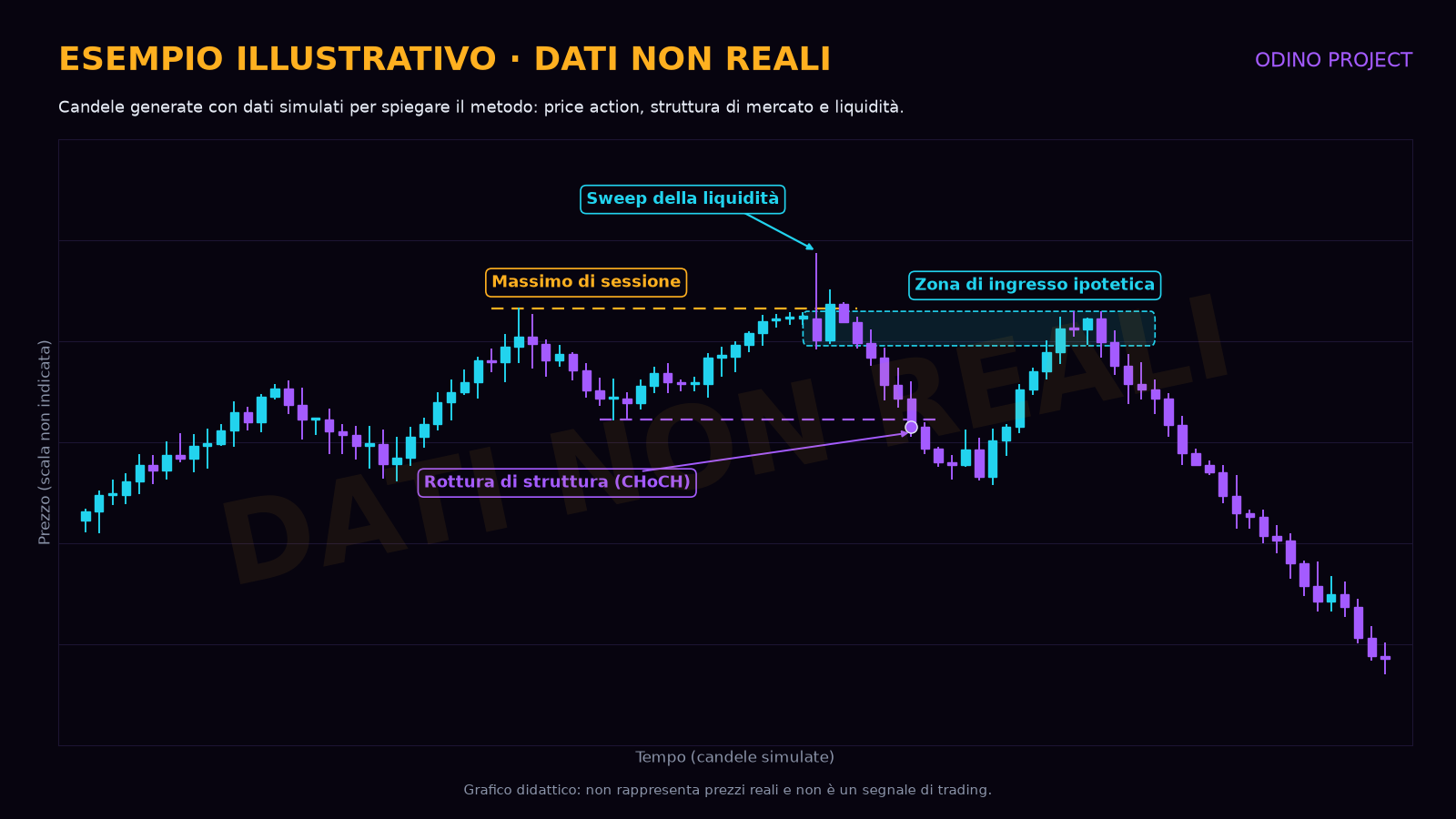
This is the framework the lessons are based on: it is meant to help you understand the method, it is not a service nor an invitation to replicate it.
Some brokers define the gold pip differently: check the symbol specifications on your platform. No method eliminates risk: losses are part of trading.
The lessons come from the work of a few automated analysis systems that operate for the project only: they are not available to the public and do not send signals. Here they share only educational lessons, drawn from market analysis and after-the-fact reviews.

Gathers the work of the analysis systems and organises it into coherent lessons.

Looks after the website and the writing of the study material.

Two systems handle the market analysis; their observations, reviewed after the fact, become the lessons on this site.

Analyses highs and lows, trends, breaks of structure and price reactions.

Analyses liquidity zones, session levels and volume patterns.
The content of this site is for educational and study purposes only. It does not constitute financial advice, trading signals or a solicitation to invest. Trading Forex, gold and CFDs involves a high risk of losing your capital and may not be suitable for everyone. Past results are not indicative of future results. Every trading decision is yours alone: if you decide to trade, only do so with capital you can afford to lose.
On this site, the Odino Project is a learning community: we study a method based on price action, market structure and liquidity applied to gold (XAUUSD) and compare notes with fellow learners. The material comes from the lessons of the project's analysis systems.
No. We do not give signals, we do not say when to buy or sell and we do not offer financial advice. All content is intended only for studying the method.
No. The Odino Project bots work only for the project owner and are not available to the public, either free or paid. Here we share only their lessons.
No, we start from the basics: what a pip is, what a stop loss is, how to read a candlestick chart. To practise, we recommend using a demo account, so you can observe the method on the chart without risking real money.
Only XAUUSD (gold against the dollar), with entries studied on the M5 timeframe and two take profits of about 300 pips each. Here 1 pip on XAUUSD is worth $0.10, so each TP corresponds to about $30 of price movement. Some brokers define the gold pip differently: check the symbol specifications.
No. No method can guarantee profits. The market changes and there are always periods of losses. Be wary of anyone promising guaranteed gains or fixed returns.
From the team's market analysis and after-the-fact reviews. Each lesson is collected in a shared lessons file, with the problem, the cause, what to do and the bot that verified it. The entries in the Help section below come from these lessons.
Common problems when comparing the lessons with your own chart or a demo account. The exact names of menus and options may vary depending on the platform you use.